Glossary of Key Terms

Here are some key terms related to ChatGPT and natural language processing:
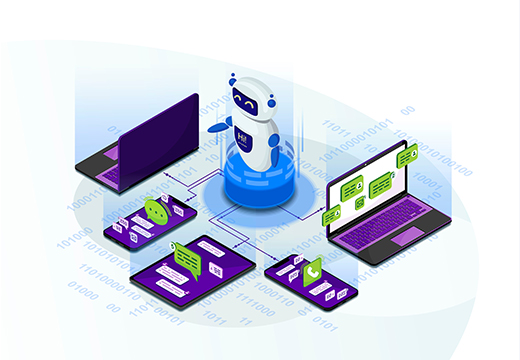
Chatbot: A computer program designed to simulate conversation with human users, often used for customer service or other applications.
Natural Language Processing (NLP): The study of how computers can process and analyze natural language data such as speech and text.
Machine Learning: A type of artificial intelligence that enables computers to learn and improve from experience, without being explicitly programmed.
Artificial Intelligence (AI): The development of computer systems that can perform tasks that typically require human intelligence, such as visual perception, speech recognition, and decision-making.
Deep Learning: A type of machine learning that uses artificial neural networks to enable computers to learn and improve from large amounts of data.
Generative Pre-trained Transformer 3 (GPT-3): An advanced natural language processing model developed by OpenAI, capable of generating highly accurate and natural language responses to a wide range of inputs.
Sentiment Analysis: The process of using natural language processing techniques to analyze and identify the emotional tone of a text or conversation.
Intent Recognition: The process of using natural language processing techniques to identify the intended meaning or purpose behind a user's input.
Accuracy: A measure of how well a natural language processing model is able to correctly identify and respond to user inputs.
Bias: The presence of systematic errors or distortions in a natural language processing model, often resulting from the data used to train the model.
Data Privacy: The protection of personal information and data collected by natural language processing models, and the ethical and legal considerations surrounding their use and storage.
Pre-processing: The process of preparing raw input data for use in natural language processing models, such as removing stop words, stemming, or tokenizing.
Tokenization: The process of breaking down text into smaller units, or tokens, for analysis and processing.
Text Generation: The process of using natural language processing models to generate new text based on existing input data.
Language Model: A statistical model used in natural language processing to predict the probability of a sequence of words or phrases.
Transfer Learning: The process of using pre-trained models to improve the performance of new models on related tasks, often used in natural language processing.
Word Embedding: A technique used in natural language processing to represent words as vectors in a highdimensional space, often used to improve the accuracy of language models.
Fine-tuning: The process of adjusting pre-trained models to perform better on specific tasks or domains.
Out-of-domain Input: Input data that is outside the scope of a natural language processing model's training data, often leading to inaccurate or irrelevant responses.
By familiarizing oneself with these key terms, users of ChatGPT can deepen their understanding of the technology and the field of natural language processing.
Other Chapters